
Rowhome and Twin Dryer Vents: Layout Problems, Fixes
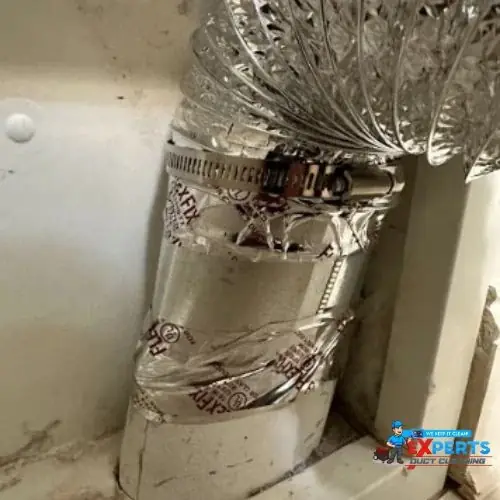
Rowhomes and twins have few exterior walls, so dryer vents often run long and bend around corners to reach one. Long runs, tight turns and crushed foil duct trap lint. Check the run against your dryer manual, use smooth rigid duct where you can, and keep the outside hood clear.
Why shared-wall homes make dryer venting harder
A freestanding house can put the laundry against an outside wall. A rowhome has a front, a back and shared walls on both sides. A twin has one shared wall. In many Philadelphia and Delaware County, PA rowhomes and twins the washer and dryer sit in the basement or a first-floor closet, far from where the vent has to exit.
So the duct runs along the joists, turns up and out through a foundation wall or rim joist, or heads for the back of the house. Every extra foot and every elbow slows the airflow and gives lint a place to settle. The dryer works harder and clothes take longer to dry. A U.S. Department of Energy job aid for installers makes the same points: long runs and excessive bends are a fire hazard and add drying time, so keep the duct short and straight, use rigid or semi-rigid metal, and end it outside with a damper and no cage.
Layout problems and what to do about them
These are the setups we see most often in shared-wall homes, with the fix that usually applies. For the duct material itself, see foil flex vs rigid dryer duct.
| Problem | What to look for | Usual fix |
|---|---|---|
| Very long run to the exit | Clothes need two cycles; laundry area runs hot | Check the maximum length in your dryer manual; reroute to a shorter path if you are over it |
| Many tight elbows | Several sharp turns between dryer and wall | Replace with fewer, gentler bends |
| Crushed or sagging foil duct | Dryer pushed tight against the wall; kinks behind it | Use smooth rigid or semi-rigid duct, and leave space behind the dryer |
| Exit hood near the ground | Hood blocked by snow, leaves, trash or storage | Keep it clear; check after storms and snow |
| Mesh screen on the outlet | Lint matted on the screen | Use a hood with a flap that opens fully, no mesh |
Rules of the road for shared-wall homes
Whatever the layout, a few points do not change. The checks behind the dryer and at the outside hood are also on the U.S. Fire Administration's dryer fire safety flyer.
- The vent must end outdoors. Never terminate it in the basement, a crawlspace, an attic, or a wall cavity, and never toward the neighbor's side of a shared wall.
- Check your dryer's manual for the longest run and the number of bends it allows.
- If you have an electric dryer that slides out easily, pull it forward about once a year and look at the duct behind it for kinks, crushing and lint at the joints. Leave gas dryers where they are and ask a pro to check behind them.
- Make sure you can reach the exit hood from outside. In a rowhome it may open onto an alley, a side passage, or a rear yard.
- Look at the hood while the dryer runs. If the flap barely moves, air is not getting out.
When to call a pro
Book a dryer vent cleaning when clothes need a second cycle, the laundry area is hot, you see lint at the hood, the run is longer than the manual allows, or the vent has never been cleaned. Lint is flammable, so a clogged vent is not worth waiting on. According to the U.S. Fire Administration, failure to clean was the leading factor, at 31 percent, in the ignition of clothes dryer fires in homes from 2018 to 2020.
Shared-wall homes also have fewer second chances. In a freestanding house the dryer can often be moved to a better wall. In a rowhome or twin the laundry spot is often fixed by the plumbing, so the vent route is the thing you can actually improve.
We serve plenty of shared-wall neighborhoods, including dryer vent cleaning in Northeast Philadelphia, Upper Darby dryer vents and Norristown dryer vents. Long runs in basements are where professional equipment helps, because it reaches farther than a hardware-store kit. If the duct itself is crushed foil, we will tell you to replace it rather than clean it. The same goes for a vent that ends in a basement or wall, which needs rerouting rather than cleaning.
Quick answers
Can I vent my rowhome dryer into the basement?
No. Dryer exhaust carries moisture and lint and must end outdoors, never in a basement, crawlspace, attic or wall cavity. If the current exit is awkward, a pro can look at rerouting options that fit your dryer's manual and local code.
Is a basement dryer vent in a twin more likely to clog?
It can be, because basement dryers often have longer runs with more turns, and lint settles in both. Watch for clothes taking longer to dry, a hot laundry area, or lint at the outside hood, and compare the run length to your manual.
How can I tell if my dryer vent is the problem?
Clothes that need a second cycle, a hot dryer or laundry area, and lint around the outside hood are common signs. Check the hood first while the dryer runs. If the flap barely moves, or nothing comes out, call a pro.
Sources
- U.S. Fire Administration: Appliance and electrical fire safety (clothes dryer fire data, 2018-2020) (opens in a new tab)
- U.S. Fire Administration: Clothes Dryer Fire Safety flyer (opens in a new tab)
- U.S. Department of Energy: Vent a Clothes Dryer, weatherization job aid 17-1 (June 2024) (opens in a new tab)
Next step
Want the vent checked? The estimate is free, and we will tell you plainly what the vent run needs.
Dryer vent cleaning in towns we serve
Related guides
- Dryer vents
Signs Your Dryer Vent Is Clogged (and What to Check)
A clogged dryer vent usually shows up as loads that need two cycles, clothes that come out hot but still damp, a warm or musty laundry room, and an outside flap that...
- Dryer vents
Foil Flex vs Rigid Dryer Duct: Which Is Better?
Smooth rigid or semi-rigid metal duct is the preferred choice for a dryer vent, because lint slides through it and it resists crushing. Thin foil accordion duct is...
- Dryer vents
How Often Should You Clean a Dryer Vent?
A common rule of thumb is once a year, then adjust. Big households, pet owners, long or bendy vent runs and foil ducts usually need it sooner. A lightly used dryer on a...